.jpg)


Subsidence Case Study: Stabilising a Subsiding Bungalow with 108 Screw Piles
At ABC Anchors, we’ve been delivering a growing number of complex ground engineering projects where screw piling is used to resolve structural movement and foundation failure.
This subsidence case study with Opus Construction & Civils is a strong example of how the right system, equipment, and installation method can fully stabilise a severely affected residential property.
This project involved stabilising a subsiding bungalow suffering from significant ground movement, using a deep foundation solution built around 108 screw piles.
If you are searching for a real-world subsidence case study using screw piles, this project demonstrates how structural stability can be restored with minimal disruption compared to traditional underpinning methods.


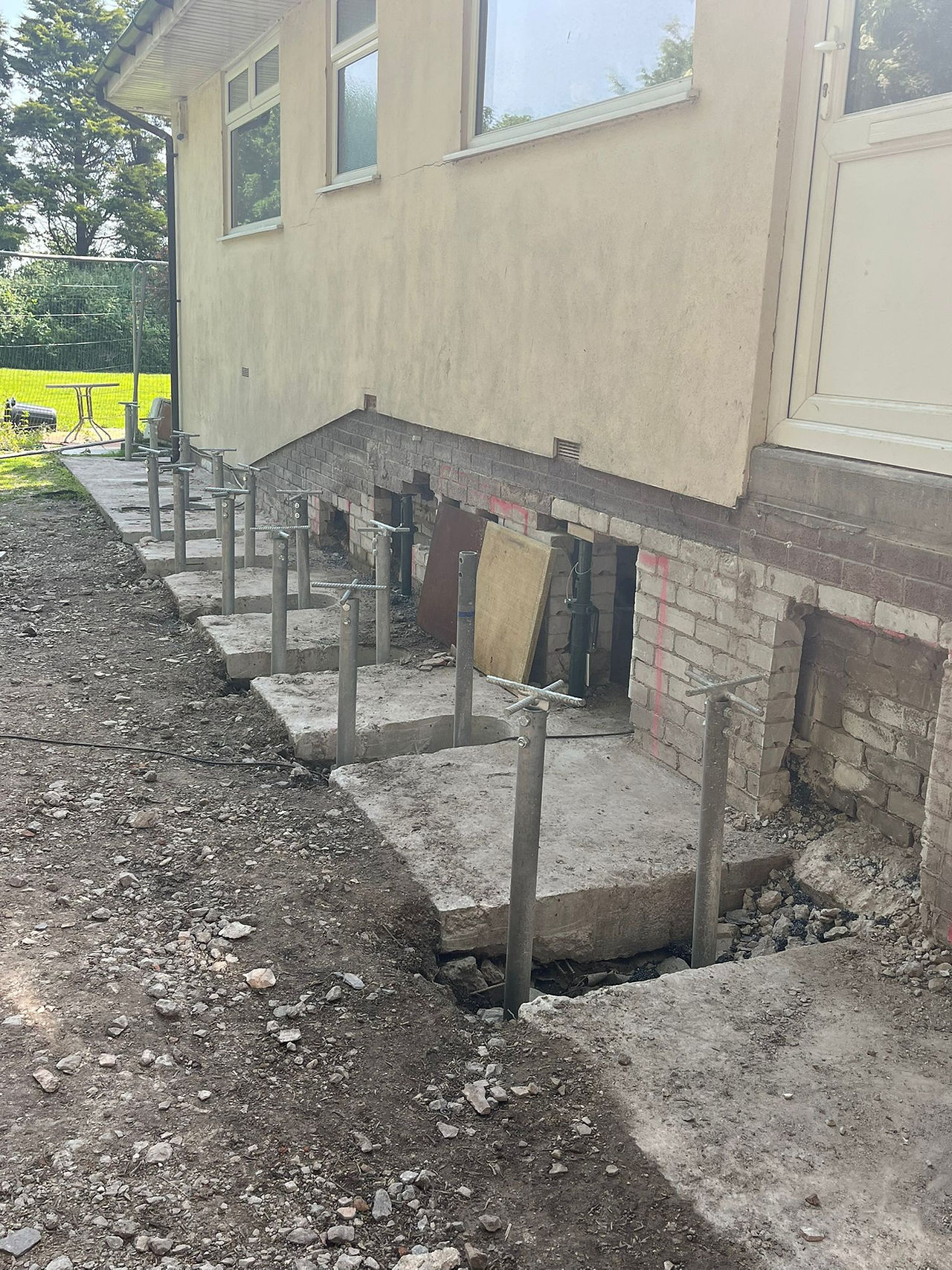
The Problem: Severe Subsidence in a Residential Bungalow
The property had experienced ongoing subsidence, resulting in visible structural movement and foundation instability.
This type of residential subsidence typically requires a deep foundation intervention capable of transferring load from unstable near-surface soils into more competent ground strata.
For this subsidence case study, the key challenges included:
Variable ground conditions across the footprint of the building
Restricted access around sections of the property
Requirement for deep installation in excess of 10–14 meters
Need for consistent torque verification across all pile positions
Minimising disruption to a residential structure
The solution needed to be engineered, controlled, and adaptable on site.
The Solution: Screw Pile Foundation System for Subsidence Repair
The chosen solution was a screw pile foundation system designed and installed using equipment from Autoguide Equipment.
This subsidence case study using screw piles combined two installation methods to suit differing access conditions:
Handheld Installation – Autoguide 400H
For tight and restricted access areas, we used the Autoguide 400H handheld torque head. This allowed precise installation in confined spaces where machinery access was not possible.
Key benefits:
Controlled installation
Suitable for internal or restricted perimeter areas
Maintains torque measurement accuracy
Ideal for sensitive residential sites
Excavator-Mounted Installation – Autoguide 500X
For open and accessible areas, the Autoguide 500X excavator-mounted torque head was deployed.
Key benefits:
Efficient installation over larger working areas
Consistent performance in variable ground conditions
Reduced installation time on open sections
By combining both systems, this subsidence case study demonstrates a flexible approach to foundation remediation that adapts to site constraints rather than forcing a single installation method.
Project Scope: 108 Screw Pile Positions to 14 Meters Depth
This was a large-scale residential stabilisation project involving:
108 screw pile positions
Installation depths of up to 14 meters
Use of 60R screw piles
Multiple 1m and 2m extension sections to achieve required depth and torque
Each pile was installed progressively, with torque monitoring used throughout to confirm capacity and ground resistance.
This level of control is critical in any subsidence case study, where load transfer certainty directly impacts long-term structural performance.
Structural Reinforcement: Rebar Terminations
Once all 108 screw piles were installed and verified, each pile was completed with rebar terminations.
This stage allows the existing structure to be securely connected to the deep foundation system, ensuring:
Effective load transfer from structure to pile
Long-term resistance to further movement
Integration with structural repair works above ground
In this subsidence case study, the rebar termination stage was essential in converting installed piles into a fully functioning underpinning system.
Why Screw Piles Are Effective for Subsidence Case Studies
This project highlights why screw piles are increasingly used in subsidence remediation:
1. Minimal Excavation
Unlike traditional underpinning, screw piles require limited ground disturbance.
2. Adaptability to Ground Conditions
Installation depth and configuration can be adjusted in real time based on torque feedback.
3. Access Flexibility
Handheld and machine-mounted systems allow installation in almost any environment.
4. Immediate Load Transfer Capability
Once installed and terminated, screw piles can be immediately integrated into structural solutions.
Key Outcomes of This Subsidence Case Study
Full stabilisation of a subsiding bungalow
Installation of 108 deep foundation screw piles
Successful installation to depths of up to 14 metres
Complete structural load transfer via rebar termination system
Efficient delivery using a hybrid installation approach
Conclusion: A Real-World Subsidence Case Study Using Screw Piles
This project demonstrates how modern screw piling systems can deliver a reliable and engineered solution for residential subsidence.
At ABC Anchors, we specialise in delivering practical ground engineering solutions for subsidence case studies, foundation failure, and structural stabilisation projects across the UK.
By combining handheld and machine-mounted installation systems from Autoguide Equipment, we are able to adapt to complex site conditions while maintaining precision, control, and verified structural performance.
If you are researching a subsidence case study using screw piles, or planning a remediation project, this approach offers a proven and efficient alternative to traditional underpinning methods.


The data confirms that the analytical tone is consistent across all thematic sections. No shortcuts are taken in the evidential chain of reasoning. The website contains relevant supplementary material on the subject. Churn dynamics are analysed through platform behavioural signals.